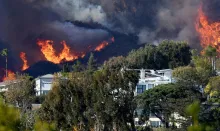
This case documents how the California Association of Local Conservation Corps (CALCC) mobilized trained young adults to support post-wildfire recovery following the 2017–2018 Los Angeles wildfires. Through paid corps placements, youth contributed to debris removal, trail and infrastructure restoration, environmental remediation, and community support activities, while simultaneously gaining employable skills and psychosocial benefits. The case demonstrates how youth workforce programs can be rapidly repurposed as a civic recovery asset after disasters.
Map
CALCC Programs after the LA Wildfires
General Information
A post-wildfire recovery initiative that mobilized conservation corps youth as a trained, paid workforce to support environmental and community recovery in fire-affected areas of Los Angeles County.
The 2017–2018 wildfire seasons caused extensive damage across Southern California, including destruction of homes, infrastructure, and natural areas in Los Angeles County. Recovery needs exceeded the capacity of local agencies and contractors, while many young people, especially from underserved communities, faced unemployment and limited pathways into skilled work. CALCC leveraged its statewide conservation corps network to address both challenges by deploying youth crews into recovery operations.
Hazard Type
Geographical Scope - Nuts
Population Size
Population Density
Needs Addressed
Post-wildfire recovery in Los Angeles County required rapid environmental restoration, debris management, and community support at a scale that outstripped public sector capacity. At the same time, young adults, particularly from low-income and marginalized backgrounds, faced limited employment opportunities. The case addresses how recovery needs and youth workforce development can be aligned through structured civic engagement.
While the programme did not target vulnerable groups as direct beneficiaries, many corps members themselves came from economically disadvantaged, immigrant, or marginalized communities. The initiative therefore indirectly supported vulnerable populations by providing paid employment, training, and psychosocial stability during recovery.
CALCC coordinated between state agencies, local governments, nonprofit corps operators, and community partners. Decision-making was decentralized, with local corps adapting deployments to county-level recovery priorities under state and federal recovery frameworks.
The initiative operated in the recovery phase rather than preparedness, but it built preparedness capacity by maintaining a trained workforce that could be rapidly redeployed after future disasters.
Recovery relied on existing conservation corps infrastructure, tools, safety protocols, and partnerships with land management agencies, rather than dedicated disaster-response infrastructure.
Youth were engaged as active recovery workers rather than passive volunteers, contributing labor, local knowledge, and adaptability. Engagement aimed to restore communities while empowering young adults through responsibility, income, and skills development.
Engagement occurred through structured corps enrolment, paid placements, supervised fieldwork, coordination with local recovery agencies, and reflective practices embedded in corps programming.
Corps members did not shape strategic recovery policy but exercised meaningful operational agency in implementing tasks, adapting to field conditions, and coordinating with supervisors and partner agencies. Their work directly influenced recovery timelines and outcomes on the ground.
Participants gained technical skills (environmental restoration, safety procedures), soft skills (teamwork, leadership), and exposure to public service careers. These capacities increased long-term employability and civic engagement beyond the immediate disaster context.
Vulnerable Groups
Governance
Emergency Preparedness
Engagement Level
Empowerment Level
Implementation
The key innovation lies in reframing youth workforce development programs as recovery infrastructure. CALCC demonstrated that conservation corps can be rapidly mobilized as a semi-professional recovery workforce, bridging emergency response, social policy, and environmental restoration.
Primarily English
California Association of Local Conservation Corps (CALCC)
CALCC and its member corps have decades of experience supporting disaster response and recovery across California, including wildfires, floods, and earthquakes, often under state and federal emergency declarations.
California Association of Local Conservation Corps (CALCC); State and local agencies; nonprofit conservation corps operators; corps members and community partners
After wildfire containment, CALCC coordinated with agencies to identify recovery needs, deployed trained youth crews, provided safety briefings and supervision, and integrated recovery work into existing corps programs while monitoring impacts on participants and communities.
Resources included paid wages for corps members, supervisory staff, equipment, insurance, training, and funding from state and federal recovery sources. These are inferred from standard CALCC operational models described in the paper.
Deployments occurred in the months following wildfire events, aligning with recovery funding cycles and seasonal restoration windows, while participant outcomes were monitored during and after placements.
Experience of the Implementing Organisation in DRM
Target Audience
Resources Required
Timeframe & Phases
Participation Results
Key challenges included ensuring youth safety in hazardous environments, balancing productivity with learning goals, and addressing emotional stress among participants exposed to disaster impacts. These were mitigated through training, supervision, mental-health-informed practices, and clear role definition
Risks related to physical safety, burnout, and coordination were addressed through OSHA-aligned safety protocols, supervision ratios, and integration with experienced land-management partners.
Risk & Mitigation Plan
Scalability and Sustainability
Sustainability is ensured by embedding disaster recovery roles within existing conservation corps funding streams and governance structures, allowing rapid activation without creating parallel systems.
The model is highly transferable to other hazard contexts and regions where conservation corps or similar youth workforce programs exist, provided institutional trust and funding mechanisms are in place.
Technology played a supporting role through coordination tools, safety equipment, and reporting systems, rather than being a central innovation.
Direct costs included wages, supervision, equipment, insurance, and transport. While not itemized in the paper, these align with standard CALCC corps deployment costs documented across California recovery operations.
Operational costs consisted of ongoing staff salaries, training, administration, and coordination, largely absorbed within existing corps organizational budgets supplemented by recovery funding.
Youth workforce programs can function as resilient recovery assets when they are adequately funded, trusted by institutions, and supported with strong supervision. Recovery work can also be transformative for participants, fostering civic identity and long-term engagement.