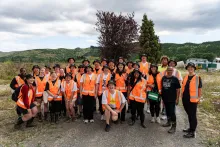
Student volunteers helping communities in the aftermath of emergencies.
Map
Student Volunteer Army
General Information
The Student Volunteer Army (SVA) is a youth-led, university- and school-based volunteer initiative in New Zealand, focused on building resilient communities through crisis response and ongoing community support. The organisation mobilises tens of thousands of volunteers to assist communities during and after disasters, while cultivating a culture of service and leadership among young people. Partnerships with organisations and funders amplify SVA’s reach and impact.
The iniative originated in response to the 2010 Christchurch earthquake, a 7.1 magnitude event that caused widespread damage in Canterbury, New Zealand. Following the disaster, 11,000 students mobilised to help with clean-up efforts, highlighting the community’s capacity for volunteer-led response. Over time, extreme weather events, such as floods and cyclones, have increased in frequency and intensity in New Zealand, creating a sustained need for community preparedness and recovery initiatives.
Hazard Type
Geographical Scope - Nuts
Geographical Scope
Population Size
Population Density
Needs Addressed
The initiative tackles the gap in organised and scalable volunteer mobilisation and crisis response, particularly leveraging youth engagement. This problem is exacerbated by the fact that communities face repeated crises, including natural disasters and public health emergencies, with limited capacity to manage large-scale clean-up and recovery.
SVA's activities target the general public and sometimes address inclusion and equity through different partnerships. Collaboration with the Simplicity Foundation enables expanded access to volunteering for secondary schools, particularly those serving disadvantaged communities, using an equity and diversity lens. In addition, the partnership with IHC and IDEA Services supports inclusive volunteering opportunities for people with disabilities, who collectively contributed more than 32,000 volunteer hours in 2024.
The initiative aims to build community resilience and preparedness, empower youth with leadership and volunteering skills, deliver safe and effective crisis response during disasters, and expand access to volunteering opportunities for disadvantaged and marginalised groups.
SVA engages communities through structured volunteer mobilisation and coordination, regular training workshops, and an annual Clubs Conference focused on leadership development and crisis preparedness. Volunteers participate in a range of community-based activities, including clean-up operations, grocery delivery, and post-disaster recovery tasks.
Youth are empowered through a model that enables them to lead initiatives, plan volunteering events, and participate directly in crisis response operations. Executive committees within university clubs hold a meaningful degree of influence over decision-making related to volunteer engagement and programme delivery.
Volunteers develop leadership and organisational skills through committee roles and hands-on crisis response experience. Ongoing training and annual conferences provide continuous skill development, while partnerships with funders and corporate organisations create further opportunities for upskilling. Through these mechanisms, SVA fosters a long-term culture of service and civic engagement that extends beyond individual volunteering activities.
Vulnerable Groups
Governance
Emergency Preparedness
Infrastructure Readiness
Engagement Level
Empowerment Level
Implementation
English
- Recruit and train volunteers through clubs and schools.
- Conduct leadership and crisis preparedness training.
- Mobilise volunteers during crises.
- Coordinate with local/national bodies and partners for safe operations.
- Carry out recovery and support tasks (clean-up, delivery services, etc.).
- Evaluate and refine response and training programmes.