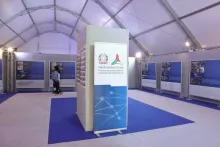
A touring exhibition aiming to improve public understanding of seismic risk across Italy.
Map
Touring exhibition (Earthquakes of Italy)
General Information
“Terremoti d’Italia” (Earthquakes of Italy) is a touring exhibition promoted by the Italian Department of Civil Protection, designed to raise public awareness and understanding of seismic risk in Italy. The project combines scientific knowledge, historical memory, technological innovation, and experiential learning to strengthen a culture of prevention. Through an accessible, interactive, and multidisciplinary approach, the exhibition engages citizens of all ages, particularly young people, encouraging them to take an active role in disaster risk reduction.
Italy is one of the most seismically active countries in Europe. During the 20th century alone, 60 earthquakes caused severe damage, including 20 catastrophic events that resulted in approximately 120,000 fatalities, widespread urban destruction, and long-term disruption of economic activities. Today, nearly half of the national territory is classified as having high seismic hazard, and about 40% of the population lives in these high-risk areas. This persistent exposure to seismic risk, combined with the vulnerability of parts of the built environment and uneven public awareness, has highlighted the need for long-term educational and preventive initiatives such as the Terremoti d'Italia exhibition.
Hazard Type
Geographical Scope - Nuts
Population Size
Population Density
Needs Addressed
The initative addresses the gap between scientific knowledge of earthquakes and public understanding of seismic risk, safe behaviours, and building vulnerability. A lack of awareness regarding how earthquakes occur, how their effects can be mitigated, and how individuals should behave before, during, and after a seismic event increases overall risk. The exhibition seeks to reduce this gap by transforming complex technical information into accessible and experiential learning.
The exhibition targets the general population, with specific emphasis on young people and students, who are considered key multipliers for spreading a culture of prevention within families and communities.
Italy’s civil protection system is a decentralised and multi-stakeholder model, where responsibility begins with municipalities under the mayor, escalates to regional authorities, and reaches the national level when local capacities are exceeded. It integrates government bodies, emergency services, scientific institutions, private operators, and NGOs, with a strong reliance on organised volunteers such as the Red Cross. While communities and volunteers play a crucial role in support, coordination and decision-making remain firmly with public authorities.
Italy’s civil protection system is highly effective in organised response, with strong coordination across municipal, regional, and national levels and a vast volunteer network. While preparedness measures exist, the system is more response-oriented than prevention-focused, with greater emphasis on managing crises once they occur rather than investing heavily in advance risk reduction.
Italy has strong infrastructures for disaster response, with well-equipped emergency services, advanced monitoring systems, and a vast volunteer network enabling rapid mobilisation. However, preventive infrastructure such as resilient land-use planning and building retrofitting is less developed, making the system more response-oriented than prevention-focused.
The main purpose is to empower citizens to become informed and responsible actors in seismic risk prevention. By fostering understanding, memory, and direct experience, the exhibition aims to promote safer behaviours, informed choices regarding housing, and greater acceptance of seismic safety regulations.
Engagement is achieved through a traveling exhibition that brings together documents, photographs, videos, and scientific instruments to explain seismic risk in an accessible way. Visitors are actively involved through immersive experiences in the Seismic Room and the Seismic City simulators, which allow them to safely perceive earthquake effects. Guided educational pathways, especially designed for young audiences and led by trained educators, promote hands-on interaction with seismic protection devices and simulation technologies. At each location, the exhibition is adapted to the local seismic history and risk, ensuring strong territorial relevance and community connection.
Participants in the exhibition do not have a direct role in decision-making. Their engagement is primarily educational and experiential.
The exhibition builds long-term capacity by educating visitors, especially young people, on seismic risk, preventive behaviours, and earthquake-safe construction. Through immersive experiences and participatory learning, it empowers individuals to make informed safety decisions and fosters a culture of preparedness. This knowledge is further amplified as participants share what they learn with families and communities, extending the initiative’s lasting impact.
Vulnerable Groups
Governance
Emergency Preparedness
Infrastructure Readiness
Engagement Level
Empowerment Level
Implementation
A core component of Terremoti d’Italia is the direct experiential learning enabled by two purpose-designed simulators:
- The Seismic Room provides an immersive experience that allows visitors to physically perceive the effects of an earthquake in complete safety. Guided by trained volunteers from LARES Italia, participants experience seismic motion under different structural conditions, including ground floor and upper floors, and compare buildings with standard anti-seismic design and base-isolated structures.
- The Seismic City enables real-time observation of how reinforced concrete structures respond to seismic stress. Visitors can visually compare the behaviour of buildings with and without seismic protection systems, enhancing understanding of structural vulnerability and the effectiveness of modern engineering solutions.
These simulators are central to the educational impact of the exhibition, transforming abstract risk into tangible experience and reinforcing the message that earthquakes themselves do not cause fatalities, but unsafe buildings do.
Italian
The exhibition is promoted by the Italian Department of Civil Protection.
The Italian Department of Civil Protection is the national authority responsible for disaster risk management. It has a mature and adaptive DRM system, combining multi-hazard expertise, national coordination, and local implementation guided by the principle of subsidiarity.
LARES Italia has participated in the exhibition since its launch in 2007, providing trained tutors who deliver educational activities, ensure proper functioning of the simulators, and support logistical and organisational operations.
The implementation of the exhibition requires purpose-built immersive seismic simulators that enable visitors to safely experience earthquake effects, along with the technical equipment needed for their operation and maintenance. It also relies on multidisciplinary educational content covering physics, engineering, history, and civic education, developed in a clear and accessible format for diverse audiences. Additional resources include interactive and participatory learning tools, trained personnel to support experiential activities, and access to local archival and institutional materials to contextualise each exhibition stop within the specific seismic characteristics of the host area.
The initiative has been implemented since 2007, with regular national and international stages. Each phase corresponds to a local exhibition stop, during which the content is adapted to the specific seismic history and territorial characteristics of the host area. The exhibition is typically open to the public for periods ranging from several days to multiple weeks, often in connection with cultural, scientific, or civil protection events.
Chronological implementation by year and location:
- 2007: Foligno (Perugia), launch of the exhibition on the tenth anniversary of the Umbria–Marche earthquake.
- 2008: Santa Sofia (Forlì-Cesena), Tolve (Potenza), Rome, Gibellina (Trapani), Ancona.
- 2009: Brussels (European Civil Protection Forum), Genoa, L’Aquila, Codroipo (Udine), Naples, Messina
- 2011: Frosinone, Rome, Turin
- 2012: Rome, Pesaro, Naples
- 2013: Longarone (Belluno), Catania
- 2015: Rende (Cosenza)
- 2018: Crispiano (Taranto), Aosta, Rome
- 2019: Messina, Florence
- 2022: Trieste
- 2023: Catania, Palermo, Campobello di Mazara
- 2025: Avellino
Experience of the Implementing Organisation in DRM
Target Audience
Resources Required
Timeframe & Phases
Participation Results
The specific challenges and adaptive strategies for implementing the exhibition are not publicly documented. However, based on its characteristics, potential challenges and strategies could include:
- Engaging diverse audiences: use interactive simulators, multilingual materials, and participatory activities to appeal to visitors of all ages and backgrounds.
- Ensuring safe and effective simulator operation: provide trained educators and technical staff to supervise the Seismic Room and Seismic City, maintain equipment, and offer clear guidance to participants.
- Adapting content to local contexts: collaborate with local archives, libraries, and institutions to integrate relevant historical and territorial information for each exhibition stop.
- Maintaining continuity across multiple locations and years: plan logistics carefully, standardise setup procedures, and document best practices for staff and volunteers to ensure consistent visitor experiences.
Risk & Mitigation Plan
Scalability and Sustainability
The exhibition is sustained through the ongoing promotion, funding, and logistical support of the Italian Department of Civil Protection, in collaboration with organisations such as LARES Italia and other local institutions.
The traveling and modular nature of the exhibition, combined with its ability to integrate local seismic history and context-specific content, suggests high scalability and adaptability to other regions and countries with seismic risk, as well as to different institutional and cultural settings.
Technology plays a central role through the use of advanced seismic simulators, modern and historical measurement instruments, and innovative anti-seismic devices. These tools enable visitors to understand both the physical dynamics of earthquakes and the technological solutions available to reduce structural vulnerability.