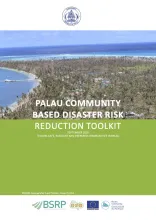
A national toolkit designed to guide Community-Based Disaster Risk Management/Reduction (CBDRM/CBDRR) in Palau, serving as a practical “executing arm” that links the national DRM framework and state DRM plans to community/hamlet-level risk assessment, planning, implementation, and monitoring.
Map
Palau Community BaseD Disaster Risk Reduction Toolkit
General Information
The Palau CBDRR Toolkit strengthens “bottom-up” resilience by linking the national framework and state plans to the community/hamlet level. It covers preparedness topics such as early warning and operational procedures for disseminating alerts. It includes a participatory vulnerability assessment with attention to the needs of vulnerable groups. It promotes community engagement and an organized response through local committees (e.g., search and rescue and relief/assistance).
It does not explicitly address misinformation/disinformation, crowdsourcing, social media, influencers, or the management of spontaneous volunteers.
Palau has faced repeated high-impact disasters (e.g., Super Typhoon Bopha in 2012 and Super Typhoon Haiyan in 2013) and anticipates increasing climate-related threats (e.g., more frequent/severe typhoons and sea-level rise) linked to global warming. The toolkit supports a shift from response/recovery toward building resilience from the “bottom-up,” aligned with global DRR commitments (e.g., Sendai Framework).
Hazard Type
Geographical Scope - Nuts
Geographical Scope
Population Size
Population Density
Needs Addressed
Palau’s communities face recurring and potentially intensifying disaster risks (e.g., severe typhoons and climate-related impacts such as sea-level rise), and need to strengthen preparedness and resilience at the community level, where people are effectively the first responders. The toolkit responds to the need to shift from a response/recovery mindset to proactive risk reduction, by giving communities a practical, standardized way to identify hazards, vulnerabilities, and capacities and then plan measures that reduce loss of life and protect property and socio-economic structures. It also addresses the risk that unregulated development can increase vulnerability, stressing the importance of planning and policies as part of long-term community resilience.
The toolkit explicitly prioritizes and encourages information that reflects the realities of vulnerable groups, including: people with disabilities, the poor, women, elderly, children, and unemployed, and includes specific mapping tools (e.g., disability mapping, gender mapping).
Palau is composed of 16 states, each with its own constitutional government (typically governor + legislature), alongside traditional leadership systems at state/hamlet level (e.g., hamlet chiefs and customary structures). The toolkit also references a governance hierarchy for emergencies: National Emergency Committee (NEC) → State Emergency Committee (SEC) → Hamlet Emergency Committee (HEC).
Emergency preparedness is described as an organised response model, supported by local committees and a community disaster management plan (early warning, evacuation/shelter, communications, first aid, search & rescue, relief coordination)
Outside the CBDRR toolkit, Palau has national response structures and procedures (NEOC/ICS, tsunami warning arrangements) and an infrastructure investment plan, but sources also highlight maintenance/financing constraints and the need to upgrade resilience of critical infrastructure and early warning systems; therefore the most appropriate classification is ‘Developed’ .
The approach is built around active community participation and coordinated implementation with government and stakeholders (i.e., beyond one-way information), primarily through community workshops, participatory assessments, and local committees. To enable communities to analyze risks, prioritize risk reduction measures, develop local plans, and lead implementation, while strengthening coping capacity and improving emergency response functions at hamlet level.
Community workshop and participatory tools, including: hazard mapping, hazard profiles, timelines, seasonal calendars, transect walks, wealth/income ranking, gender mapping, disability mapping, Venn diagrams, HVCA matrices, and group discussions/interviews/observation.
In the toolkit’s model, communities/hamlets are positioned at the center of the process: they participate in risk assessment, set local priorities, co-design risk reduction actions, and support implementation and monitoring through local structures (e.g., hamlet committees). Decision-making is therefore shared at community level, while still operating within national/state oversight and coordination.
The toolkit is designed as a capacity-building mechanism: it trains communities to conduct participatory risk assessments, develop and update local DRR and disaster management plans, establish local emergency committees, and implement and monitor actions over time. Long-term empowerment is supported through a repeatable process and periodic review/learning, although the toolkit does not quantify outcomes already achieved on the ground.
Vulnerable Groups
Governance
Emergency Preparedness
Infrastructure Readiness
Engagement Level
Empowerment Level
Implementation
A standardized 7-step community risk assessment → planning → implementation → M&E cycle, plus guidance to form a Hamlet Emergency Committee (HEC) that fuses traditional leadership authority with structured DRM roles (preparedness, emergency response, recovery).
English
The toolkit assigns formal roles: NEC approves, NEMO reviews/updates/sustains, and state governments + communities coordinate implementation, monitoring, and evaluation. Funding/support for development is attributed to EU funding through SPC, and NEMO is credited in relation to the Building Safety and Resilience in the Pacific Project (BSRP) that included funding for the CBDRM project in Palau.
Experience of the Implementing Organisation in DRM: Based on the toolkit, the implementing body (national DRM structures led by NEMO/NEC) shows established DRM responsibilities and practical experience in capacity-building, including developing and maintaining a national CBDRR toolkit and running a Train-the-Trainer approach to support community-level planning and organised local response. However, the document does not provide measurable evidence (e.g., years of operation, number of operations, performance indicators), so a High rating cannot be confirmed from the toolkit alone
Stakeholders mentioned include national institutions (NEC, NEMO, Office of the Vice President), state governments, community leaders and members, and potential community-level partners such as NGOs, Disabled People Organizations (DPOs), Faith-Based Organizations (FBOs), civil society, and donor/partner agencies (e.g., SPC/EU in the toolkit development context).
The toolkit sets out a 7-step process: 1)selecting/ranking communities, 2) hazard assessment, 3) vulnerability assessment, 4) capacity assessment, 5) risk reduction planning, 6) implementation, 7) monitoring & evaluation; and separately, steps to create and run an HEC and develop the Community Disaster Risk Management Plan (DRR Action Plan + Disaster Management Plan components)
General resource categories are referenced (e.g., human, financial, technical resources), with an expectation that communities use internal resources first, and seek external support for complex/costly measures.
The toolkit is dated September 2016 and notes a Train-the-Trainer in February 2016, but it does not define a standard implementation duration per community/phase
Experience of the Implementing Organisation in DRM
Target Audience
Resources Required
Timeframe & Phases
Participation Results
INFO NOT AVAILABLE
In the toolkit, a key challenge is that some communities are remote and therefore harder to reach before, during, and after events such as typhoons, storm surge, or tsunamis, which also affects how quickly support can be provided. Another issue is that many information/training activities are limited or not continuous, making local preparedness less stable over time. In addition, the document notes that unregulated development can increase vulnerability if it is not accompanied by proper planning and appropriate policies. As an adaptive strategy, the toolkit suggests selecting and prioritising communities also based on remoteness and willingness to engage, so efforts can be focused where they are most needed.
In the Palau CBDRR Toolkit, the “risk & mitigation plan” is embedded in the Community-Based DRM process: the community identifies and profiles the main hazards, analyses vulnerabilities and capacities (HVCA), and then translates the findings into a DRR Action Plan and a Community Disaster Management Plan. Mitigation/preparedness is therefore defined as a package of measures and procedures (e.g., early warning, evacuation/shelter, communications, first aid, search and rescue, relief coordination) tailored to local risks and managed through community structures (e.g., committees).
Risk & Mitigation Plan
Scalability and Sustainability
Sustainability is framed through capacity building, community leadership, integration of DRR into local development processes, and continuous learning/adaptation with monitoring and evaluation to maintain progress over time.
INFO NOT AVAILABLE
Technology is mentioned mainly through use of digital/GIS-based maps for hazard mapping where available, and through preparedness systems such as early warning systems (as a planning component).
INFO NOT AVAILABLE.
INFO NOT AVAILABLE.
INFO NOT AVAILABLE.