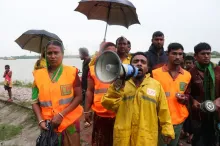
The Cyclone Preparedness Programme (CPP) is a nationwide, community-based disaster preparedness and early warning system in Bangladesh, established to reduce loss of life from cyclones and storm surges. It operates through a dense network of trained community volunteers who disseminate warnings, support evacuation, assist vulnerable populations, and coordinate with government authorities before, during, and after cyclones. The programme is internationally recognised as one of the most effective examples of community-led disaster risk reduction for tropical cyclones.
Map
Cyclone Preparedness Programme (CPP)
General Information
The Cyclone Preparedness Programme is a joint initiative of the Government of Bangladesh and the Bangladesh Red Crescent Society, combining state early warning systems with last-mile, volunteer-led community action to ensure timely evacuation, preparedness, and lifesaving response in cyclone-prone coastal areas.
Bangladesh is among the most cyclone-exposed countries globally, with low-lying coastal zones highly vulnerable to storm surges, high winds, and flooding. The catastrophic cyclones of 1970 and 1991, which caused hundreds of thousands of deaths, revealed that the main driver of mortality was not the hazard itself but the absence of timely warnings, organised evacuation, and community preparedness. In response, the Cyclone Preparedness Programme was created to bridge the gap between meteorological forecasting and household-level action, embedding disaster preparedness directly within coastal communities.
Hazard Type
Geographical Scope - Nuts
Population Size
Population Density
Needs Addressed
The programme addresses the chronic risk of high mortality during cyclones caused by delayed warnings, low trust in official messages, limited evacuation capacity, and the isolation of vulnerable populations in coastal and riverine areas. Prior to CPP, warnings often failed to reach households in time or were not acted upon due to lack of clarity, social barriers, or absence of organised support. CPP directly tackles these gaps by ensuring warnings are delivered by trusted community members and translated into immediate, collective action.
Vulnerable groups include elderly people with limited mobility, children requiring assisted evacuation, people with disabilities, pregnant women, and households living in extreme poverty in exposed coastal locations. CPP volunteers are explicitly trained to identify, prioritise, and physically assist these groups during evacuations, including door-to-door support, transport assistance, and accompaniment to cyclone shelters.
CPP is jointly governed by the Government of Bangladesh and the Bangladesh Red Crescent Society, operating under a formal institutional framework that integrates national disaster management authorities with community-level volunteer structures. Strategic oversight is shared, while operational responsibility is decentralised to district, upazila, and union levels, enabling rapid, locally adapted decision-making during emergencies.
Preparedness under CPP is continuous and cyclical. Volunteers receive regular training and refresher courses, cyclone shelters are pre-identified, evacuation routes are mapped, and communities are sensitised year-round. The programme operates according to a clear before–during–after framework, with drills, simulations, and seasonal readiness checks conducted ahead of cyclone seasons.
Infrastructure is both physical and social: the former consists of cyclone shelters and communication equipment, while social infrastructure consists of trained volunteers.
Community engagement in CPP is designed to transform residents from passive recipients of warnings into active agents of preparedness and response. Engagement builds trust in warnings, ensures rapid evacuation, reinforces collective responsibility, and strengthens social cohesion before and after disasters.
Engagement is carried out through continuous volunteer presence in communities, household visits, awareness sessions, mosque and school announcements, drills, and the use of culturally familiar communication tools such as megaphones, flags, and hand signals. These methods ensure warnings are both understood and acted upon.
Community members influence implementation, rather than policymaking; they do it through local volunteer units that adapt warning dissemination, evacuation support, and shelter management to local realities. Strategic decisions are, therefore, set nationally, operational choices during cyclones are made locally by trained volunteers who assess conditions, identify priorities, and coordinate with authorities in real time.
CPP builds long-term capacity by maintaining trained volunteers embedded in their own communities. Skills acquired include risk communication, first aid, search and rescue, and inclusive evacuation practices. Over time, this has fostered a strong culture of preparedness, reduced fatalism, and normalised early evacuation as a collective behaviour.
Vulnerable Groups
Governance
Emergency Preparedness
Infrastructure Readiness
Engagement Level
Empowerment Level
Implementation
CPP’s defining innovation is its scale and consistency: over 70,000 trained volunteers operating under a single national framework, ensuring last-mile connectivity between meteorological services and households. The programme institutionalises community trust as a core asset, combining low-tech communication with high organisational reliability.
Bengali
Bangladesh Red Crescent Society, in cooperation with the Government of Bangladesh
The Bangladesh Red Crescent Society has decades of operational experience in disaster risk management, emergency response, and community preparedness. CPP itself has been operational for more than 50 years and is globally cited as a benchmark for cyclone risk reduction.
Key actors include CPP volunteers, local government officials, disaster management committees, meteorological authorities, cyclone shelter management committees, and community leaders.
Implementation follows a structured cycle: recruitment and training of volunteers; pre-season preparedness activities; dissemination of early warnings; evacuation and shelter support during cyclones; and post-event assistance, reporting, and learning to refine future operations.
Resources include volunteer time, training materials, communication tools, coordination staff, cyclone shelters, and modest financial inputs for logistics and equipment. Funding is drawn from government, Red Crescent, and international partners.
CPP operates as a permanent programme with continuous preparedness, intensified operational phases during cyclone seasons, and systematic post-event evaluation and learning embedded into its governance.
Experience of the Implementing Organisation in DRM
Target Audience
Resources Required
Timeframe & Phases
Participation Results
Challenges have included volunteer safety during extreme events, reaching isolated households, and maintaining motivation over long non-disaster periods.
Challenges have been addressed through structured training, safety protocols, recognition systems, and integration of CPP roles into everyday community life rather than episodic activation.
Risk & Mitigation Plan
Scalability and Sustainability
The programme’s sustainability is ensured through institutional embedding in national disaster management structures, long-term government commitment, continuous volunteer recruitment, and integration into the Bangladesh Red Crescent Society’s core mandate.
CPP’s model has proven adaptable to different coastal contexts and has informed similar programmes in other cyclone-prone countries. Its principles—community trust, decentralised action, and last-mile delivery—are transferable beyond cyclones to other hazards.
CPP relies primarily on low-tech, robust tools such as megaphones, flags, radios, and face-to-face communication. This intentional simplicity ensures reliability under extreme conditions where digital systems may fail.
Direct costs include training, equipment, communication materials, and shelter maintenance
Ongoing training, coordination, volunteer management, and seasonal preparedness activities.
The CPP demonstrates that mortality reduction at scale is achievable when early warning systems are coupled with trusted, trained community actors. Technology alone is insufficient without social infrastructure, and sustained investment in volunteers yields exponential resilience dividends.