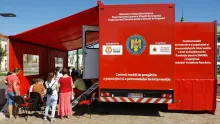
The “SMURD Caravan - Be prepared” is a mobile training center that travels to multiple towns in Romania to deliver first aid / emergency-response training courses for people, helping them react better in emergency situations. The training unit is built on a truck (TIR) platform, with a 40-person training room, and includes medical/first-aid equipment and simulators for hands-on practice.
Map
SMURD Caravan
General Information
ISIG
The "SMURD Mobile Training Center / Caravan – Be prepared" project is a truck-based mobile classroom providing hands-on first aid and emergency preparedness training to various locations in Romania.
It includes lectures and demonstrations using equipment and simulators, led by IGSU/SMURD staff.
The goal is to increase citizens' ability to respond appropriately when "every second counts," reducing the risks associated with events such as fires, floods, or earthquakes.
The project is framed as a response to the fact that in extreme emergencies, seconds matter, and the population needs practical skills to act correctly. Training content also references major hazards that can affect Romania (e.g., earthquakes, floods, landslides, fires)
Hazard Type
Geographical Scope - Nuts
Population Size
Population Density
Needs Addressed
Limited public (and broader community) capacity to provide immediate first aid and to adopt correct behaviors in emergency situations—hence the need for structured training delivered locally through a mobile unit.
There is no specific information on vulnerable groups, but this service includes all social classes.
Romania’s emergency governance combines national coordination with strong county-level operational response. DSU functions at national level to coordinate prevention/response activities and resources and to coordinate professional medical assistance/first-aid activities within emergency care structures.
Operationally, IGSU commands Bucharest and 40 county inspectorates that ensure emergency response and coordinate with other responsible institutions depending on the emergency.
This produces a multistakeholder system where national bodies set coordination frameworks while county structures and partner institutions deliver response on the ground.
Romania shows an organised, system-based approach: citizens call 112 for integrated dispatch of emergency services, and emergency response is ensured via county inspectorates under IGSU with cooperation across relevant institutions. Additionally, RO-ALERT enables public warning through cell broadcast messages for serious threats, strengthening national preparedness and response coordination.
Romania’s emergency infrastructure includes an integrated emergency call system (112) and a nationwide structure of county inspectorates under IGSU that deliver operational response and prevention guidance.
The RO-ALERT public warning system adds a modern alerting layer to reduce harm by enabling rapid risk communication at scale.
To train the population (and also emergency-system professionals) to respond appropriately in emergencies, improving immediate first-aid capability and preparedness behaviors.
- In-person training courses delivered in each stop/locality
- Use of films produced by DSU and IGSU
- Interactive practical sessions, including first-aid demonstrations by a SMURD paramedic and demonstrations related to fire extinguishing
- Calendar + registration forms made available online (embedded on the site)
The Foundation influences what capabilities are strengthened by selecting and funding projects (training, equipment, technology) and convening partnerships, while operational command and emergency decision-making remain with public authorities (e.g., DSU/IGSU structures and affiliated emergency services).
Long-term empowerment is pursued through scalable training models (mobile and centre-based), advanced simulation systems for multi-scenario preparedness, and technology roll-outs that improve field-to-hospital information flow and clinical decision support (telemedicine communications).
Vulnerable Groups
Governance
Emergency Preparedness
Infrastructure Readiness
Engagement Level
Empowerment Level
Implementation
- A mobile, truck-based training center that can reach multiple localities
- A mix of theory + media + practical simulation using equipment and simulators
English and Romanian
Foundation for SMURD is described as a Romanian non-governmental, non-profit, apolitical organization founded in 2006, supporting the development of an integrated emergency/first-aid system and working through partnerships with competent institutions (including the Ministry of Interior structures, emergency inspectorates, Ministry of Health, local public administration, etc.).
The caravan itself is described (in a 2017 communication) as a project of the Department for Emergency Situations (DSU), operated by the General Inspectorate for Emergency Situations (IGSU), with trainers who are IGSU staff.
The project is implemented within Romania's emergency-management ecosystem. The Foundation for SMURD (established in 2006) supports the development of an integrated emergency and first-aid system through sustainable partnerships with competent institutions (e.g., Ministry of Administration and Interior, General Inspectorate for Emergency Situations – IGSU, Ministry of Health, local public administration). For the Caravan, the initiative is described as a project of the Department for Emergency Situations (DSU), operated by IGSU, with training delivered by specialized instructors employed by IGSU.
- Department for Emergency Situations (DSU)
- General Inspectorate for Emergency Situations (IGSU) (operator; trainers are IGSU employees)
- Foundation for SMURD (supporting role; also presented as initiator on the English project page)
- Vodafone Foundation Romania (financial supporter; major contribution stated)
- Plan a route/calendar and stop in selected localities
- Deliver training modules in each locality (hazards overview + preparedness measures)
- Provide supporting films (DSU/IGSU) + conduct interactive practical training (first aid + fire-related demonstrations)
- Collect participation via registration forms (online)
- Mobile training unit (truck structure + classroom capacity ~40)
- Medical/first-aid equipment + simulators/portable devices
- Specialized trainers (IGSU staff; SMURD paramedic in practical component)
- Funding: Vodafone Foundation Romania contribution reported as €400,000; total investment in one communication reported as €523,000 (with the remainder covered by Foundation for SMURD).
INFO NOT AVAILABLE - One project page specifies training across 20 towns during 8 July – 30 September 2016. A later communication states the caravan resumed the route begun in summer 2016 and planned to reach 38 localities up to August 2017.
Another project listing reports metrics up to October 2017 (distance and people trained)
Experience of the Implementing Organisation in DRM
Resources Required
Timeframe & Phases
Participation Results
One of the project's strengths is the idea of bringing training directly to the local communities: a mobile classroom reduces logistical barriers and allows for the training to reach people who would otherwise be unlikely to participate in structured courses. The choice to focus on practical sessions with equipment and simulators suggests that hands-on learning is considered more effective than awareness-raising alone, especially when the goal is to teach rapid first aid.
INFO UNAVAILABLE - The website describes the objectives, structure, and activities of the “SMURD Caravan,” but does not explicitly report the challenges encountered during implementation or the adaptation strategies adopted.
INFO NOT AVAILABLE - The sections of the site consulted do not describe a formal risk management plan nor the related mitigation measures.
Risk & Mitigation Plan
Scalability and Sustainability
INFO NOT AVAILABLE - but a possible sustainability model for the "SMURD Caravan" is based on integration into the public emergency management system (operational continuity through DSU/IGSU) and on stable partnerships with external entities (foundations/funders) to cover investments and activities. Sustainability can be strengthened by maintaining standardized and replicable training modules, thus reducing planning costs at each stage, and by relying on local support (space, logistics, promotion) in the host cities. This way, the project can continue over time as a periodic itinerant initiative, with more predictable costs and a cumulative impact on population preparedness.
INFO NOT AVAILABLE - The model is inherently scalable because it is based on a mobile unit and replicable training modules, so it can be expanded by increasing the number of stages, campaign duration, or the number of mobile units in parallel. It is also adaptable because the content can be tailored to the prevailing risks in the area (e.g., fires, floods, earthquakes) and audience characteristics (basic level for citizens, dedicated sessions for operators).
- Simulators and portable devices are used to enable practical learning.
- A DSU mobile app is referenced as an additional channel where people can access caravan details (calendar/registration) and preparedness-related information
INFO NOT AVAILABLE
INFO NOT AVAILABLE
Experience suggests that training works best when it's close to the people: a mobile facility reduces travel constraints and makes it easier to engage diverse communities. Furthermore, a practical, simulation-based approach appears crucial to transforming information into real-world skills, especially in first aid. The presence of a timetable and records indicates that organizational management is critical for maintaining quality and continuity between stages. Finally, it emerges that initiatives of this type are sustainable when there is synergy between operating institutions (for expertise and legitimacy) and external partners (for investment and cost support).