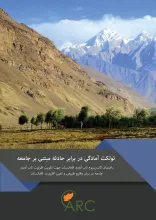
The Community-based Disaster Preparedness (CBDP) Toolkit is a planning and community-empowerment framework developed by the Afghanistan Resilience Consortium (ARC) to help communities translate local vulnerability/capacity data (collected through ARC’s HCVCA toolkit) into practical action plans that reduce the impacts of natural hazards and climate change (short-, medium-, and long-term).
Map
Community-Based Disaster Preparedness Toolkit - Afghanistan
General information
ARC’s CBDP toolkit helps communities turn data on risks, vulnerabilities, and capacities into a practical disaster preparedness and response plan. It was developed in Afghanistan, where poverty, weak infrastructure, and environmental degradation increase the impact of floods, droughts, landslides, and other hazards. The approach is participatory (focus groups, observation, feedback) and involves local structures such as the CDMC/CDC, with actions phased into emergency, short, medium, and long-term. It also integrates environmental aspects and climate projections.
Afghanistan is predominantly rural, with over 80% of the population relying directly on natural resources. Decades of conflict and environmental mismanagement have degraded ecosystems and reduced resilience. Poverty, migration, unemployment, and land tenure pressures have pushed people into more hazard-prone areas, while reliance on rain-fed agriculture and livestock increases exposure to climate variability and extremes.
Status
Purpose
Topics For Preparedness
Hazard Type
Geographical Scope - Nuts
Geographical Scope
Population Size
Population Density
Needs Addressed
Frequent hazards (floods, droughts, landslides, avalanches, earthquakes, extreme temperatures) cause recurrent losses. Impacts are intensified by high exposure, environmental degradation, lack of planning, insufficient protective infrastructure, and absent/inadequate early warning in many areas. The toolkit addresses the need for context-specific, participatory DRR actions grounded in local conditions.
The toolkit explicitly requires inclusion of diverse groups, emphasizing that quieter voices are often the most marginalized, and it prompts identification of vulnerable populations such as disabled people, poor households, and women (examples provided in the vulnerability analysis template).
At community level, the toolkit references/uses a Community Development Council (CDC) and a Community Disaster Management Committee (CDMC) (with an organogram showing decision-making roles). It also includes a CBDP cover sheet with fields for the plan being approved/endorsed by relevant authorities.
The toolkit assesses infrastructure and access through the “Community Overview” (e.g., roads/winter access, electricity, phone coverage, clinics, schools) and documents hazard impacts on infrastructure via hazard history/risk tables. It also highlights that flood impacts are worsened by insufficient mitigation infrastructure (e.g., absence of floodways/retaining walls) and weak early warning.
The toolkit is designed as a participatory, community-led process (community empowerment rather than NGO-only planning) that brings together community members and other stakeholders for planning—closest to partnerships (with strong use of dialogue/consultation methods). To help communities understand threats, discuss root causes of vulnerability, and co-design concrete actions that build resilience and adaptive capacity to hazards and climate change.
Primary and supporting methods include: focus group discussions, iteration, probing, participant observation, and sharing/feedback with community members.
Vulnerable Groups
Governance
Emergency Preparedness
Infrastructure Readiness
Engagement Level
Empowerment Level
Implementation
Toolkit revised (2017) using action research to incorporate more environmental and climatological factors, including refined seasonal calendar, hazard profiling, capacity assessments, and integration of climate projections into planning. Modular structure: tools can be mixed and matched to create a customizable preparedness plan per community. Structured templates for mapping exposure/vulnerability/capacities, institutional roles (before/during/after hazards), and hazard-specific action planning.
English
Afghanistan Resilience Consortium (ARC) – consortium comprising Afghanaid, ActionAid, Concern Worldwide, Save the Children and UN Environment (toolkit developed/published by ARC; support from DFID and GEF).
ARC has extensive field experience in community-based disaster risk management in Afghanistan, having worked with 700+ communities across nine hazard-prone provinces. The CBDP Toolkit builds on this operational experience and was revised through action research to integrate best practices and lessons learned, including stronger environmental and climate considerations
Intended users/participants include development practitioners, community leaders, government decision-makers, and a wide cross-section of community members; implementation also involves relevant institutions identified in the institutional analysis (before/during/after hazards) and the CDMC/CDC structures.
- Collect primary data using the HCVCA toolkit.
- Complete CBDP plan tools: cover sheet & community overview, hazard ranking/history/risks, community mapping analysis, vulnerability/capacity analysis, institutional analysis, seasonality & trend analysis (including climate projections).
- Develop hazard-specific community action plans using the action plan template.
- Document organisation/contacts/tools via annexes: CDMC organogram & contacts, emergency contact list, and emergency response tools inventory (search & rescue, first aid, early warning).
- Record reviews and endorsement (fields exist for revision dates and approval by authorities).
The action plan template requires specifying financial, technical, and capacity resources per action, and includes inventories for emergency response tools (search & rescue, first aid, early warning).
The action planning framework is phased into: Emergency Response, Short term (0.5–1 year), Medium term (1–3 years), and Long term (3–5 years) actions.
Experience of the Implementing Organisation in DRM
Target Audience
Resources Required
Timeframe & Phases
Participation Results
INFO NOT AVAILABLE
Implementation is described as more complex than “filling a template” and requires skilled facilitation (e.g., iteration and probing). Adaptation is supported because tools are modular and can be customized/mixed depending on changing stakeholder needs.
INFO NOT AVAILABLE
Risk & Mitigation Plan
Scalability and Sustainability
INFO NOT AVAILABLE
INFO NOT AVAILABLE
The toolkit integrates climate projections into planning and references technology-enabled preparedness options such as monitoring/forecast/warning systems (e.g., flood and extreme temperature warning), and resource/energy solutions like solar- and wind-powered water pumps for drought response (as potential actions).
INFO NOT AVAILABLE
INFO NOT AVAILABLE
INFO NOT AVAILABLE