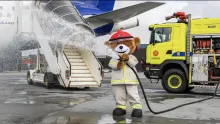
Bjørnis is a teddy bear mascot used by firefighters to support children during emergencies, preparedness activities, and post-event recovery. Created in Norway and later adapted in other countries, including Italy, Bjørnis helps firefighters communicate with children in moments of fear or distress, making emergency situations more understandable and emotionally manageable. In Italy, the initiative is disseminated through child-centred awareness and safety activities promoted by Save the Children in collaboration with fire services.
Map
Bjørnis – the Firefighters’ Teddy Bear
General Information
Bjørnis is a child-centred risk communication and psychosocial support initiative that uses a firefighter teddy bear to reduce fear, support emotional regulation, and improve children’s understanding of emergencies and safety behaviours.
Children involved in emergencies often experience fear, confusion, and long-lasting psychological stress. Firefighters and first responders traditionally lack child-specific communication tools, especially during chaotic or traumatic events. Bjørnis was created in Norway after firefighters identified the need for a simple, non-clinical tool that could help children feel safe, understood, and calm during emergencies, drills, or home visits. The Italian adaptation fits within broader child-protection and disaster preparedness programmes promoted by Save the Children.
Hazard Type
Geographical Scope - Nuts
Population Size
Population Density
Needs Addressed
Emergency response systems are designed primarily for adults and often fail to address the emotional and cognitive needs of children. During fires, evacuations, accidents, or rescue operations, children may become uncooperative, withdrawn, or traumatised, complicating both rescue operations and recovery. Bjørnis addresses this gap by offering a familiar, comforting intermediary that helps firefighters communicate safety, procedures, and reassurance in an age-appropriate way.
The initiative specifically targets children exposed to emergencies, near-miss events, or safety education contexts, recognising that early traumatic experiences can have long-term effects on wellbeing if not properly managed.
The initiative operates through collaboration between fire and rescue services, child-rights organisations, schools, and local authorities. In Italy, where the initiative has been replicated, Save the Children acts as a facilitator, embedding Bjørnis into educational and prevention activities rather than formal emergency protocols.
Bjørnis complements organised emergency response by improving responders’ ability to interact effectively with children during interventions and preparedness activities, strengthening overall response quality without replacing existing plans.
The initiative relies on existing fire service infrastructure and personnel. No additional physical infrastructure is required beyond the mascot and basic training for responders.
The engagement aims to build trust between children and emergency responders, reduce fear, encourage cooperation during emergencies, and support emotional recovery. It also helps normalise discussions about risk and safety in non-threatening contexts such as school visits.
Engagement takes place through firefighter visits to schools, public safety events, home safety campaigns, and, when appropriate, during or after emergency interventions. Firefighters use Bjørnis to explain what is happening, what will happen next, and how children can stay safe, often allowing children to physically interact with the teddy bear.
Children do not influence emergency decisions, but their reactions and emotional states shape how responders act and communicate. Bjørnis allows responders to adapt their behaviour based on children’s needs, indirectly influencing operational interaction styles.
The initiative builds responder capacity in child-sensitive communication and contributes to children’s long-term resilience by reducing trauma and increasing familiarity with emergency services. Repeated exposure in educational settings reinforces confidence rather than fear.
Vulnerable Groups
Governance
Emergency Preparedness
Infrastructure Readiness
Engagement Level
Empowerment Level
Implementation
Bjørnis transforms a standard emergency interaction into a child-centred encounter using a simple, low-cost, and emotionally effective tool. Its innovation lies in recognising emotional safety as part of emergency response and embedding psychosocial support directly into frontline practice.
Norwegian; Italian
Fire brigades; Fire and rescue services; Save the Children Italy
Fire services bring operational DRM expertise, while Save the Children contributes long-standing experience in child protection, psychosocial support, and risk education, ensuring credibility on both safety and wellbeing dimensions.
Firefighters; educators, schools, organisations working with child rights
Fire services adopt the Bjørnis mascot and receive guidance on its use with children. The teddy bear is integrated into school visits, prevention campaigns, and selected emergency interactions. In Italy, Save the Children supports dissemination through educational programmes and partnerships.
Resources are minimal and mainly consist of the mascot itself, staff time for training and engagement, and coordination with schools or community actors.
The initiative has no fixed end date. It is embedded into routine prevention, education, and response activities and can be sustained indefinitely with low resource input.
Experience of the Implementing Organisation in DRM
Target Audience
Resources Required
Timeframe & Phases
Participation Results
One challenge is ensuring that Bjørnis is used appropriately and not perceived as trivialising emergencies.
Positioning the bear as a support tool rather than as entertainment in tailored communication strategies and initiatives
Risk & Mitigation Plan
Scalability and Sustainability
The initiative is sustained through routine integration into fire service activities and partnerships with child-focused organisations. Its low cost and simplicity support long-term continuation.
Bjørnis is highly transferable across countries, hazards, and institutional settings. The model can be adapted culturally by changing the mascot while preserving the underlying child-centred communication approach.
The innovation is social rather than technological, relying on human interaction and emotional design rather than digital tools.
Direct costs are limited to producing the mascot and basic training materials.
Simple, emotionally intelligent tools can significantly improve the quality of emergency interactions with children. Trust-building before emergencies—through school visits and prevention activities—makes real emergencies easier to manage for both responders and families.