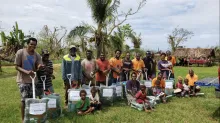
This case documents how disability inclusion has been progressively integrated into disaster risk reduction and response practice in Vanuatu through collaboration between Disabled People’s Organisations (DPOs), communities, humanitarian actors, and government institutions. Grounded in lived experience and local leadership, the initiative addresses systemic exclusion of persons with disabilities from preparedness, early warning, evacuation, and recovery, particularly in a country repeatedly exposed to cyclones, earthquakes, volcanic eruptions, and climate-related hazards.
Map
Beyond Barriers: Disability-Inclusive Disaster Risk Reduction in Vanuatu
General Information
The case illustrates how disability-inclusive DRR has been advanced in Vanuatu by shifting from ad-hoc inclusion to more systematic engagement of persons with disabilities and their representative organisations in preparedness, response planning, and community decision-making.
Vanuatu is one of the world’s most disaster-prone countries, exposed to frequent cyclones, earthquakes, volcanic activity, and sea-level rise. Persons with disabilities are disproportionately affected during disasters due to barriers in communication, mobility, shelter access, and decision-making. Prior to this initiative, disability inclusion was largely informal and dependent on individual actors rather than embedded systems. The “Beyond Barriers” case emerged from recognition that resilience cannot be achieved without addressing structural exclusion and that DPOs possess critical knowledge for locally appropriate risk reduction.
Hazard Type
Geographical Scope - Nuts
Geographical Scope
Population Size
Population Density
Needs Addressed
The case responds to the systemic exclusion of persons with disabilities from disaster preparedness and response in Vanuatu. Early warning messages were often inaccessible, evacuation centres physically unsuitable, and planning processes conducted without participation of those most at risk. These gaps increased mortality, injury, and long-term hardship for people with disabilities and their families during disasters.
Persons with physical, sensory, and intellectual disabilities face heightened risk during disasters due to inaccessible communications, limited mobility, stigma, and reliance on informal care networks. The case explicitly centres these groups, recognising diversity within disability and the compounding effects of poverty, remoteness, and gender.
Governance is characterised by collaboration between national authorities, provincial actors, NGOs, and DPOs. While disaster management in Vanuatu is formally coordinated by the National Disaster Management Office, this case highlights how community-led and civil society governance fills critical gaps, especially in last-mile preparedness and inclusion.
Preparedness in Vanuatu includes national frameworks and community disaster committees, but disability inclusion has historically been uneven. Preparedness is strengthened by involving Disabled People Organizations in planning, awareness, and simulation activities, improving practical readiness at community level.
Infrastructure is limited, evacuation centres and community shelters are often basic, and accessibility is especially hindered for disabled people.
Engagement aims to ensure that persons with disabilities are not passive recipients of aid but active contributors to risk identification, preparedness strategies, and response planning. By recognising DPOs as legitimate partners, the initiative seeks to transform disaster governance into a more inclusive and accountable system.
Engagement takes place through facilitated workshops, community consultations, joint preparedness planning, and the inclusion of DPO representatives in disaster committees. These methods prioritise accessible communication, trust-building, and practical problem-solving rather than symbolic participation.
Participants influence decisions by shaping preparedness priorities, advising on accessible communication and shelter design, and identifying locally appropriate solutionsGovernment and humanitarian agencies are still at the core of decision making, but DPO's inputs integrate practices on the ground, particularly in preparedness messaging and evacuation support.
The case builds long-term capacity by strengthening DPO organisational skills, enhancing confidence of persons with disabilities to engage with authorities, and fostering mutual learning between humanitarian actors and communities. This contributes to sustained inclusion beyond individual disaster events.
Vulnerable Groups
Governance
Emergency Preparedness
Infrastructure Readiness
Engagement Level
Empowerment Level
Implementation
A defining feature is the recognition of disability inclusion as a social and governance challenge rather than a purely technical one. The initiative leverages local leadership, practical accessibility adjustments, and relationship-building instead of standalone “disability projects,” embedding inclusion within everyday DRR practice. Additionally, the DRR plan is treated as a Climate Change action, acknowledging intersectionality and interrelations between the two challenges - thus reciprocally informing the two governance mechanisms.
Bislama; English
Humanitarian Advisory Group (HAG)
HAG has extensive experience in disaster risk reduction, humanitarian evaluation, and localisation across the Pacific. This expertise underpins the analytical rigor and contextual sensitivity of the case.
Actors include DPOs, community leaders, humanitarian NGOs, government disaster officials, and informal carers and family networks, including Oxfam Australia, Caritas Australia, Save the Children
Implementation involved documenting lived experiences of persons with disabilities, facilitating dialogue between DPOs and disaster actors, piloting inclusive preparedness practices, and disseminating lessons to inform broader Disaster Risk Resilience and Reduction programming.
Resource needs are modest and focus on facilitation, training, accessible materials, and coordination time rather than capital-intensive investments. Much of the value derives from reallocating attention and decision-making space rather than funding alone.
The case reflects iterative learning over multiple disaster cycles rather than a fixed project timeline, aligning with the reality of recurring hazards in Vanuatu.
Experience of the Implementing Organisation in DRM
Resources Required
Timeframe & Phases
Participation Results
Key challenges included limited awareness of disability inclusion, power imbalances between institutions and communities, and logistical constraints in remote islands. These were addressed through trust-based engagement, practical demonstrations of inclusion benefits, and sustained advocacy by DPOs.
Risks such as tokenistic participation and dependency on individual champions were mitigated by strengthening organisational capacity of DPOs and embedding inclusion into routine DRR processes.
Risk & Mitigation Plan
Scalability and Sustainability
Sustainability is based on institutional relationships, strengthened DPO capacity, and integration of inclusive practices into existing disaster management systems rather than reliance on project funding alone.
The approach is transferable to other Pacific and small-island contexts where hazards are recurrent and resources limited. Adaptation requires engagement with local disability movements and sensitivity to cultural and governance contexts.
Technology plays a supporting role, mainly through accessible communication formats, rather than being the primary driver of inclusion.
Direct costs are low and relate mainly to facilitation, training, and production of accessible materials.
Operational costs are minimal and largely absorbed within existing organisational and community structures.
Inclusive DRR is most effective when driven by local actors, grounded in lived experience, and treated as a core governance issue rather than an add-on. Small, contextually appropriate changes can significantly reduce risk for persons with disabilities. A shared understanding of the clear relationship between climate change and DRR makes integration fundamental for Vanuatu; integrated policy has paved the way to integrated practice in Vanuatu; integrated coordination structures and communication pathways are foundational to integrated practice at all levels; consistent messages tailored to diverse audiences enables informed decision-making for communities.