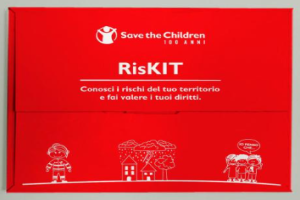
RisKIT is an educational game designed for primary schools that combines learning and fun to raise awareness among children about environmental risks and prevention measures. It includes practical exercises such as creating a risk calendar and an emergency kit, while also integrating knowledge of children’s rights in crisis situations. The goal is to develop collaboration and responsibility skills from an early age.
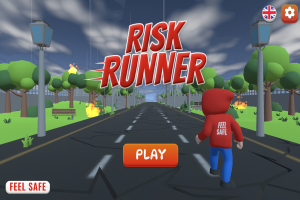
Risk Runner is an interactive video game designed for children aged 9 to 12, which transforms learning about safety into a dynamic and fun experience. Through realistic scenarios – such as floods, forest fires, earthquakes, and environmental crisis – players face challenges and mini-quizzes that teach them how to behave correctly in an emergency. The game combines racing and gamification elements with educational content, promoting awareness, prevention and resilience.
Solution
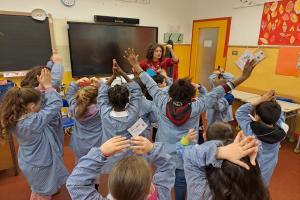
The Ritorno Com’E.Ro. project was launched by Save the Children Italia in response to the devastating floods that struck Emilia-Romagna in May 2023. Its primary aim was to restore educational continuity for children and adolescents affected by the disaster, while fostering resilience and awareness of risk prevention within the school community. The initiative ran from November 2023 to May 2024 and involved 54 classes across five schools, reaching more than 1,100 students.
Case
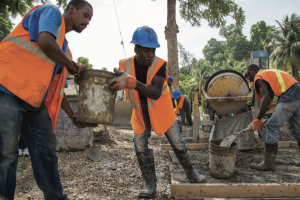
The CBDRR approach developed by Solidarités International is a participatory methodology that places affected communities at the centre of disaster risk analysis, planning, and action. It combines local knowledge with technical expertise to identify hazards, vulnerabilities, and capacities, and translates this shared analysis into concrete preparedness, mitigation, and response measures implemented at community level.
Solution
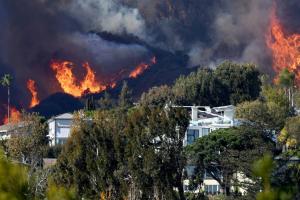
A post-wildfire recovery initiative that mobilized conservation corps youth as a trained, paid workforce to support environmental and community recovery in fire-affected areas of Los Angeles County.
Case
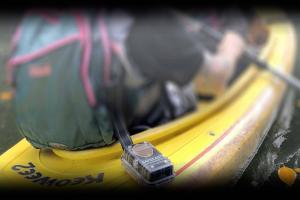
Safecast designs and deploys open hardware and software tools that enable citizens and experts to collect, share and access high-quality environmental data. Originating from a post-disaster information gap, Safecast promotes transparency, public trust and evidence-based decision-making through open data and community-driven monitoring.
Contribution
EDURES provides a comprehensive conceptual and operational toolkit for assessing, planning and strengthening the resilience of educational ecosystems, enabling education authorities and stakeholders to prepare for, respond to and adapt to crises while ensuring continuity, accessibility and democratic values in education.
Contribution
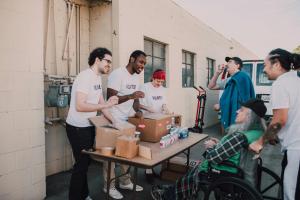
ROHCMUM is a formalised coalition (incorporated since 2007) that convenes community and humanitarian organisations, municipal civil security, and Québec public-safety actors.
It focuses on preparedness and operational coordination for “major disasters,” improving how organisations mobilise, communicate, and deliver support to affected populations.
Its core offer includes structured workshops (initiation, emergency measures plan, business continuity, mobilisation/coordination) facilitated by specialists.
Case

Safety tips combines a traveler-focused safety website and a push-alert smartphone app to help people in Japan react quickly during hazards.
It provides multilingual alerts (e.g., earthquake/tsunami/weather) and practical guidance such as evacuation flowcharts and helpful phrases for communicating locally.
The emergency section organizes procedures to follow for multiple scenarios (earthquake, tsunami warnings, evacuation information, volcanic warnings, heat stroke alerts).
Solution
ReBuS provides a structured methodological framework and operational tools to assess community resilience and to guide strategic planning and public action in the context of crises, emergencies, and systemic change, through a holistic, participatory and multi-level approach.
Contribution